
Garden suite property value Toronto is an important topic for homeowners who want to understand whether building a backyard suite is actually worth the investment.
On paper, a garden suite can look very attractive. It can create rental income, add usable living space, improve resale appeal, and give your property more long-term flexibility. However, the real question is not only whether you can build one. The more important question is whether the project makes financial sense after construction cost, design fees, permits, financing, maintenance, vacancy, taxes, and future resale value are all considered.
In many cases, a well-planned garden suite can increase property value and create strong long-term benefits. It can be used as a rental unit, a private space for family, a home office, or a future downsizing option. But like any major construction project, it should be reviewed carefully before you spend money on drawings, permits, or construction.
This guide explains how garden suites can affect property value in Toronto, how to calculate ROI, what costs to expect, what risks to watch for, and when a garden suite may or may not be the right investment.
Table of Contents
- Do Garden Suites Increase Property Value?
- How a Garden Suite Creates Value
- Garden Suite Cost Example
- Rental Income and Net Cash Flow
- Payback Period: Rent Alone
- Real ROI: Rent + Property Value
- When a Garden Suite May Not Be Worth It
- What Affects Garden Suite ROI?
- How to Maximize Garden Suite ROI
- Why Feasibility Comes First
- Garden Suite FAQ
Garden Suite Property Value Toronto: Do Garden Suites Increase Property Value?
Yes, garden suites can increase property value in Toronto, especially when they are legal, well-designed, properly permitted, and able to generate rental income.
A garden suite adds value by creating a separate living space in the backyard. Depending on the homeowner’s goals, it can be used as a rental unit, a private space for family, a home office, a caregiver suite, or a future downsizing option.
For many buyers, this kind of flexibility is attractive. They are not just buying a house; they are buying a property with more options for income, family use, and long-term value.
A garden suite can create value in three main ways: monthly rental income, higher resale value, and long-term flexibility for family or lifestyle needs. The important point is that the value is not only about rent. A garden suite can also improve the overall use, flexibility, and marketability of the property.
To see how backyard suite and addition projects can be presented visually, you can also visit our Garden Suite and Addition Portfolio.
If you are planning a backyard suite and want to understand the full process, you can also review our Garden Suite and Laneway House Services page for more details about planning, design, permits, and construction.
| Value Source | How It Helps | Why It Matters |
|---|---|---|
| Rental Income | Creates monthly cash flow from a separate backyard unit. | Can help offset construction cost and improve long-term ROI. |
| Property Value | Adds a legal secondary dwelling to the property. | Can make the home more attractive to buyers looking for income or flexibility. |
| Family Flexibility | Can be used for parents, adult children, guests, office space, or future downsizing. | Adds lifestyle value even if the unit is not rented immediately. |
How a Garden Suite Creates Property Value
A garden suite can increase property value because it gives the property more usable options. Instead of functioning only as backyard space, the lot can include a separate living unit that may be rented, used by family, or kept as a flexible space for the future.
This is one reason many Toronto homeowners are paying attention to garden suites. Housing costs are high, rental demand remains strong, and many families are looking for practical ways to create more living space without buying another property. A legal and well-designed garden suite can make a home more useful, more flexible, and more attractive to future buyers.
1. Rental Income
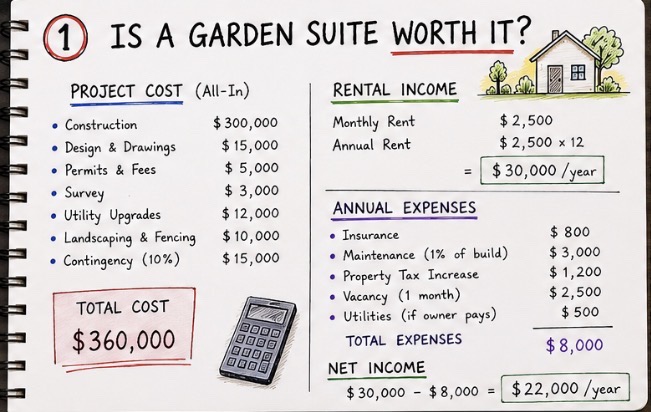
One of the main benefits of a garden suite is the potential rental income. For example, if a garden suite rents for $2,500 per month, the gross rental income would be $30,000 per year.
However, gross rent is not the same as profit. Homeowners also need to account for expenses such as insurance, maintenance, repairs, vacancy, possible property tax increases, utilities if they are included, and financing costs if the project is funded with borrowed money.
A more realistic way to review the numbers is to look at net income. For example, a garden suite with $30,000 in annual gross rent and approximately $8,000 in annual expenses would produce an estimated net income of $22,000 per year.
This is why garden suite ROI should always be calculated using net income, not just gross rent.
2. Higher Resale Value
A legal garden suite can also improve resale value because it makes the property more useful and more attractive to a wider range of buyers.
Some buyers may be interested in the rental income. Others may want a private space for parents, adult children, guests, or a home office. For investors and long-term homeowners, the value comes from having a property with more flexibility and more ways to use the space.
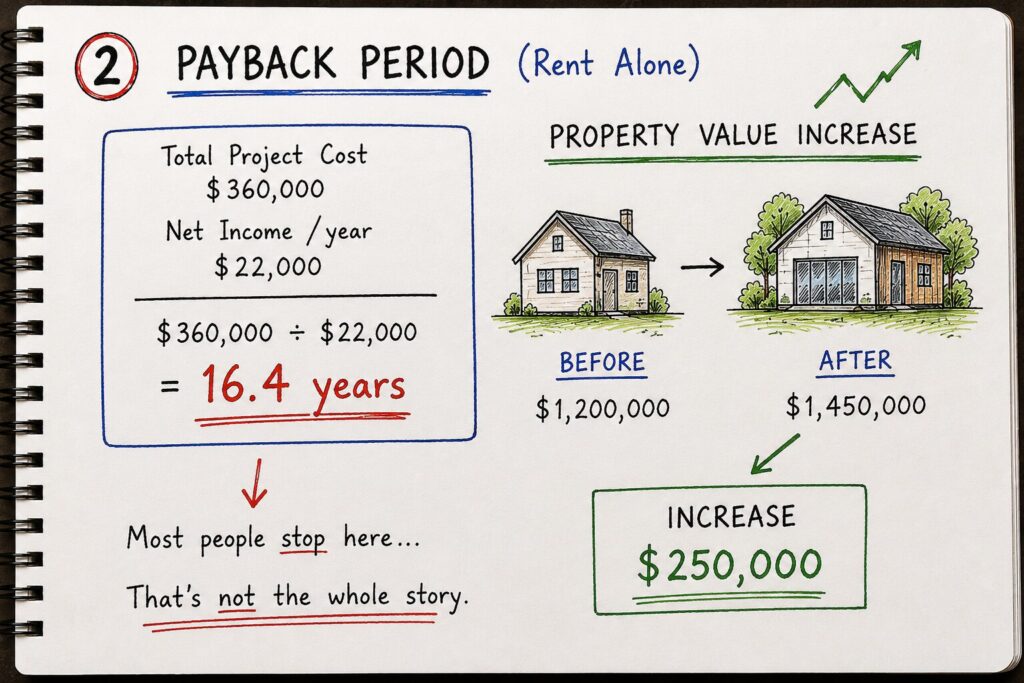
For example, a home valued at $1,200,000 before building a garden suite may be worth around $1,450,000 after the project, depending on the location, design, rental potential, and market conditions. In this example, the estimated value increase would be about $250,000.
This number is only an example, not a guarantee. The actual increase in property value depends on the neighbourhood, suite size, build quality, legal permits, rental income potential, and buyer demand. The main point is that a garden suite can add value beyond monthly rent by making the property more flexible and more attractive for resale.
3. Family Flexibility
Not every homeowner builds a garden suite for rental income. Some homeowners use it for aging parents, adult children, a caregiver, guests, a private office, or even a future downsizing option.
This kind of flexibility has real value. In Toronto and the GTA, many families want to stay close to each other while still having privacy and independence. A garden suite can create that separation without the need to buy another property.
For some homeowners, the family and lifestyle value may be just as important as the rental income. It gives the property more options today and more flexibility for the future.
If your main goal is to create more living space inside the main home, you may also want to compare this option with a Home Addition.
Garden Suite Cost Example in Toronto
Garden suite cost in Toronto can vary depending on size, design, site conditions, access, servicing, finishes, and permit requirements.
For a simple ROI example, let’s use a total project cost of $360,000. This may include construction, design and drawings, permits, survey, utility upgrades, landscaping, fencing, and contingency.
This is why homeowners should not only ask, “How much per square foot?” A garden suite has many costs beyond the building itself. Design, permits, servicing, access, utility upgrades, and site restoration can all affect the final budget.
Before starting full drawings, it is better to review the property, access, zoning, tree conditions, servicing, and rough budget. This helps you understand whether the project is realistic before spending too much money upfront.
| Cost Item | Example Budget |
|---|---|
| Construction | $300,000 |
| Design and Drawings | $15,000 |
| Permits and Fees | $5,000 |
| Survey | $3,000 |
| Utility Upgrades | $12,000 |
| Landscaping and Fencing | $10,000 |
| Contingency | $15,000 |
| Estimated Total Project Cost | $360,000 |
This example shows why garden suite pricing should not be judged only by square footage. Even a small backyard unit can include design, permits, servicing, site preparation, utility upgrades, and contingency. A proper budget should include the full project scope, not only the building itself.
For a broader look at project budgets, you can also visit our Renotec Pricing Guide to compare typical renovation and construction costs before starting your garden suite planning.
Rental Income and Net Cash Flow
Assume the garden suite rents for $2,500 per month. That would create $30,000 in annual gross rent before expenses.
However, gross rent is only the starting point. To understand the real return, homeowners should also include estimated annual expenses such as insurance, maintenance, repairs, vacancy, property tax changes, utilities if included, and financing costs.
After these expenses, the net income may be lower than the gross rent. For example, if the annual gross rent is $30,000 and estimated annual expenses are $8,000, the estimated net income would be $22,000 per year.
A common mistake is to calculate ROI using only rent. That can make the numbers look better than they really are. A serious homeowner should include expenses from the beginning so the investment is reviewed more honestly.
This kind of calculation builds trust, reduces surprises, and gives homeowners a clearer picture of whether the garden suite makes sense.
| Rental Income Example | Amount |
|---|---|
| Monthly Rent | $2,500 |
| Annual Gross Rent | $30,000 |
| Estimated Annual Expenses | $8,000 |
| Estimated Net Income | $22,000 / year |
Payback Period: Rent Alone
If a garden suite costs around $360,000 and produces an estimated net income of $22,000 per year, the rent-only payback period would be about 16 years.
At first, this may sound like a long time. But rent is only one part of the full investment picture. A garden suite can also increase the resale value of the property, especially when it is legal, well-designed, and attractive to future buyers.
For example, if the suite adds approximately $250,000 in property value, the homeowner may not be risking the full construction cost from a long-term equity point of view. The project still requires a major upfront investment, but part of that investment may be reflected back in the property’s market value.
That is why garden suite ROI should not be reviewed only as a rent payback calculation. A better approach is to look at both sides of the return: the yearly cash flow from rental income and the long-term value added to the property.
Real ROI: Rent Plus Property Value
A better way to look at garden suite ROI is to include both net income and estimated property value increase.
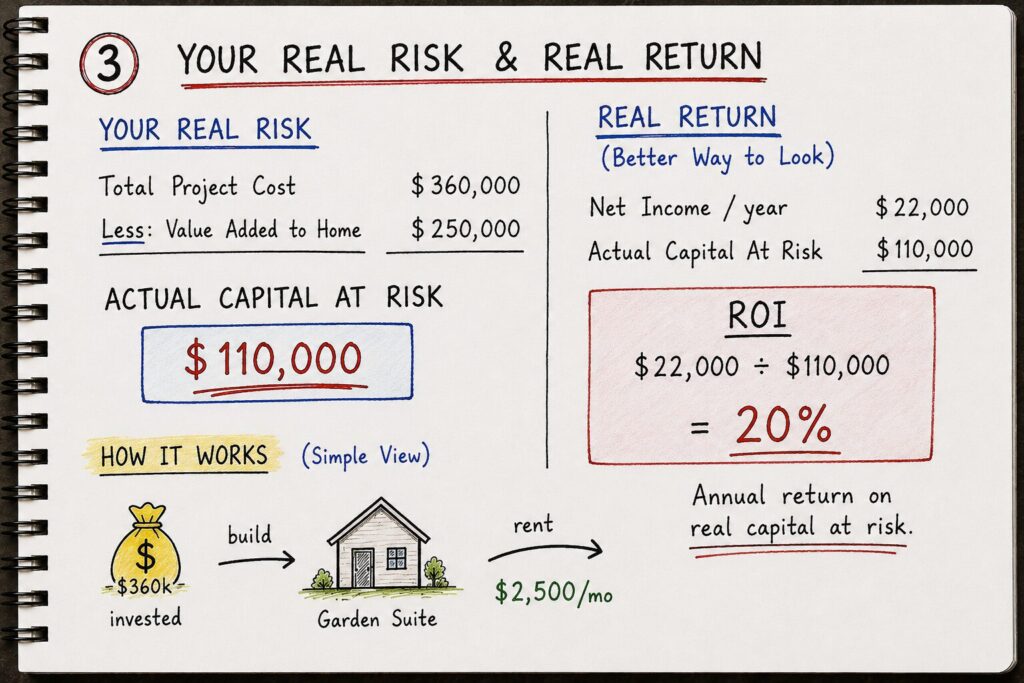
Using the same example, let’s say the total project cost is $360,000 and the garden suite adds approximately $250,000 in property value. In that case, the estimated capital still exposed may be closer to $110,000.
If the suite also produces around $22,000 per year in net income, the return on the capital still exposed could be much stronger than the rent-only payback period suggests.
This does not mean every garden suite will produce this kind of return. The actual ROI depends on construction cost, rent, financing, property value, taxes, expenses, vacancy, and market conditions.
But it shows why looking only at payback period can be misleading. A garden suite is not just a rental unit. It can also be a value-add real estate improvement.
| Garden Suite ROI Example | Amount |
|---|---|
| Total Project Cost | $360,000 |
| Estimated Value Added to Property | $250,000 |
| Estimated Capital Still at Risk | $110,000 |
| Estimated Net Income / Year | $22,000 |
| Estimated Return on Capital at Risk | 20% |
When a Garden Suite May Not Be Worth It
A garden suite is not always the right investment. This is important to understand before spending money on drawings, permits, and construction planning.
A garden suite may not be worth it if the lot has poor construction access, major tree protection issues, expensive utility upgrades, low expected rent, high financing costs, or limited usable backyard space. It may also not be the right fit if the homeowner does not want to manage tenants or if the project creates too many servicing, grading, drainage, or layout challenges.
This is why the first step should not be construction. It should be a feasibility review. Before investing heavily in design, drawings, permits, or construction planning, you need to understand whether your property is actually a good candidate for a garden suite.
A proper feasibility review can help identify lot limitations, access issues, servicing requirements, tree protection concerns, rough construction costs, rental potential, and whether the project makes financial sense before you move forward.
A feasibility review can help answer important questions: Can a garden suite fit on this lot? Is there proper access? Are there tree protection issues? Will utilities need upgrades? What is a realistic budget? What rent could the unit likely generate? Does the investment make sense?
This is where many homeowners need professional guidance before spending serious money.
If a full garden suite is not the right fit for your property or budget, a Garage Conversion may be another option to explore, depending on your existing structure, zoning, and long-term goals.
Not Sure If a Garden Suite Makes Sense for Your Property?
Before you spend money on drawings or permits, Renotec can help you review your lot, budget, access, rental potential, and possible ROI from a practical construction point of view.
Book a Garden Suite Feasibility ReviewWhat Affects Garden Suite ROI?
Garden suite ROI depends on more than one number. The most important factors include location, size, layout, build quality, legal compliance, utility upgrades, financing cost, vacancy, and maintenance.
Location
A garden suite in a high-demand rental area may generate stronger rent and attract more resale interest. Location matters because it can affect both monthly rental income and future buyer demand.
Size and Layout
A smart layout can make even a small garden suite feel more spacious and comfortable. Features like good storage, natural light, privacy, and functional room planning can also make the unit more appealing to renters.
Build Quality
A low-cost build may save money at the beginning, but it can lead to maintenance issues later. Durable finishes, proper waterproofing, good insulation, and reliable mechanical systems are important for long-term performance and tenant satisfaction.
Legal Compliance
A legal, permitted garden suite can be stronger for resale, insurance, financing, and tenant confidence. It is better to avoid shortcuts because they can create expensive problems later.
Utility Upgrades
Utility upgrades can affect the overall garden suite budget. Electrical, water, sewer, heating, cooling, and drainage requirements should be reviewed early because some properties may need more upgrades than others.
Financing Cost
Financing costs should be included in the garden suite ROI calculation. A project may look strong before borrowing costs, but the return can become weaker once monthly loan payments and interest are added.
Vacancy and Maintenance
Every rental property needs a realistic maintenance budget. Repairs, regular maintenance, vacancy, insurance, and long-term replacement items should be included when calculating the true return on a garden suite.
Other Important Factors Homeowners Should Consider
A garden suite is not only a spreadsheet decision. There are lifestyle, family, and long-term planning factors too.
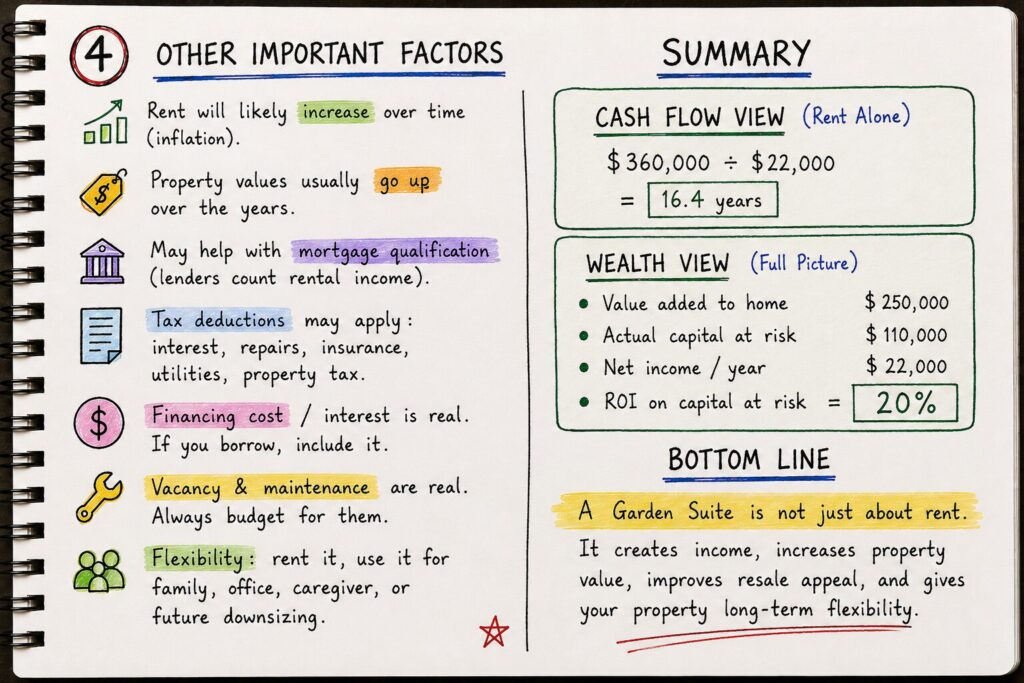
Rent may increase over time. Property values may increase over the years. Rental income may help with mortgage qualification in some cases. Some rental-related expenses may be deductible, but homeowners should confirm this with an accountant. Vacancy and maintenance are real and should be budgeted. The suite can also be used for family, office, caregiver, guests, or future downsizing.
The best garden suite projects are planned with both financial and lifestyle goals in mind.
How to Maximize Garden Suite ROI
The best garden suite investment is not always the cheapest build. A strong investment balances construction cost, smart design, durability, rental appeal, and future resale value.
Before spending money on full drawings, start by reviewing the property. Check the zoning, construction access, trees, servicing, setbacks, drainage, and rough construction cost to see whether the lot is a good candidate for a garden suite.
A garden suite should also be designed for real use. A good layout, useful storage, natural light, sound control, proper heating and cooling, and privacy can make the unit more attractive to quality tenants.
It is also important not to overbuild. Luxury finishes can look attractive, but they do not always increase rent enough to justify the extra cost. It is usually better to spend money on upgrades that improve durability, comfort, functionality, and long-term value.
A realistic budget should include more than construction. It should also include design, permits, survey, engineering, servicing, landscaping, contingency, and possible utility or site upgrades.
Building legally is another important part of protecting the investment. A legal, permitted garden suite is usually stronger for resale, insurance, financing, and peace of mind. Shortcuts may seem faster at the beginning, but they can create expensive problems later.
Even if you plan to keep the property long term, it is smart to build with future buyers in mind. A clean, legal, functional, income-producing garden suite is easier to explain, easier to market, and easier to sell.
For homeowners and investors comparing different ways to add housing value, our Multiplex Conversion Toronto page may also be helpful.
Why Feasibility Comes First
Garden Suite ROI Review Process
Before investing in drawings, permits, or construction, homeowners should review the full picture: cost, zoning, rental income, expenses, property value, and long-term goals.
Lot Feasibility Review
Review lot size, access, trees, setbacks, servicing, and site limitations.
Estimate Project Cost
Include construction, design, permits, servicing, landscaping, and contingency.
Check Zoning & Permits
Confirm zoning, permit requirements, drawings, and approval path before moving forward.
Review Rent Potential
Estimate realistic monthly rent based on location, layout, privacy, and market demand.
Calculate Expenses
Include maintenance, vacancy, insurance, utilities, taxes, and financing costs.
Estimate Value Increase
Review how a legal garden suite may affect resale value and buyer appeal.
Compare ROI & Payback
Compare rent-only payback with the full picture of income and property value.
Decide If It Fits
Move forward only if the cost, rent, resale value, and long-term goals make sense.
Many homeowners make the mistake of starting with drawings too early. Drawings are important, but before drawings, you need to know whether the project makes sense.
A feasibility review can help you understand whether your lot can support a garden suite, what the approximate construction cost may be, whether there are servicing or access issues, whether tree protection may affect the design, and whether the project is worth moving forward.
Renotec helps homeowners review the project from both a practical construction and investment point of view. The goal is not to push every homeowner to build. The goal is to help you understand the risks, costs, rental potential, and long-term value before you spend serious money.
Helpful Official Resources
Before starting a garden suite project, homeowners should review official requirements for zoning, building permits, fees, and financing options. These resources can help you understand what may be required before design or construction begins.
- City of Toronto Garden Suites — Official Toronto information about garden suites and how they fit into the city’s housing options.
- City of Toronto New Garden Suite Permit Guide — Official permit guide for a new garden suite in Toronto.
- Toronto Pre-Approved Garden and Laneway Suite Plans — City information about pre-approved garden and laneway suite plans.
- City of Toronto Building Permit Fees — Official fee information for building permits, including new garden or laneway suites.
- Ontario Guide to Adding a Second Unit — Provincial information about adding a second unit and building permit requirements.
- CMHC Refinance for Building Secondary Suites — CMHC information about refinancing to help create secondary suites.
Related Renotec Resources
You may also want to review these related Renotec resources before planning your garden suite project.
Final Thoughts: Is a Garden Suite Worth It?
A garden suite can be worth it if the property, budget, rent, design, and long-term plan make sense.
It may not be right for every homeowner. Some properties have poor access, expensive utility upgrades, tree issues, limited space, or rental numbers that do not justify the cost. Some homeowners may also prefer to keep their backyard open or avoid the responsibility of managing tenants.
But for the right property, a garden suite can be one of the strongest long-term improvements a Toronto homeowner can make. It can create monthly rental income, increase property value, support family needs, improve resale appeal, and give the property more flexibility for the future.
The most important step is to look at the full picture before building. A garden suite is not just about rental income. It is about turning underused backyard space into a flexible, income-producing asset that can support your property, your family, and your long-term financial goals for years to come.
For homeowners comparing garden suite property value Toronto opportunities, the best starting point is a feasibility review that looks at cost, rent, resale value, and long-term use.
Thinking About a Garden Suite in Toronto or the GTA?
Renotec can help you review the project from a practical construction and ROI point of view before you spend money on the wrong plan.
Book a Garden Suite ConsultationFrequently Asked Questions About Garden Suite ROI in Toronto
Yes. A legal and well-designed garden suite can increase property value because it adds a separate dwelling, rental income potential, and long-term flexibility. The actual value increase depends on the location, design, permits, build quality, rental demand, and resale market.
The value added can vary widely. In a simple example, a garden suite may add around $250,000 to a property, but this is not guaranteed. The real number depends on the neighbourhood, size, rent potential, construction quality, and buyer demand.
If a garden suite costs $360,000 and produces $22,000 per year in estimated net income, the rent-only payback period is about 16.4 years. However, this does not include the possible increase in property value, which can improve the overall return.
No. Garden suite ROI should include rental income, property value increase, financing cost, maintenance, insurance, vacancy, property tax changes, and utility upgrades. Looking only at rent can make the investment look better than it really is.
Rent depends on the location, size, layout, finishes, privacy, and market conditions. Homeowners should use a conservative rent estimate first and compare it with current rental listings before making a final investment decision.
Include insurance, maintenance, repairs, vacancy, property tax increase, utilities if paid by the owner, financing cost, and long-term replacement items such as appliances, roofing, HVAC, and finishes.
It depends on the property and budget. A basement apartment may cost less if the structure already exists, but a garden suite can offer more privacy, better separation, more natural light, and stronger resale appeal in some cases.
Yes. A garden suite requires proper design, zoning review, and building permits. Homeowners should review City of Toronto requirements and work with qualified professionals before starting construction.
In some cases, lenders may consider rental income, but every lender has different rules. Speak with a mortgage professional before relying on future garden suite rental income for mortgage qualification.
Yes, it can still be worth it if you need space for aging parents, adult children, a caregiver, a home office, guests, or future downsizing. In that case, the value is not only financial; it is also lifestyle and flexibility.
Garden suite property value Toronto depends on location, design quality, legal permits, rental income, construction cost, servicing, access, and buyer demand. A well-planned suite can add value, but the numbers should be reviewed before starting drawings or construction.